














































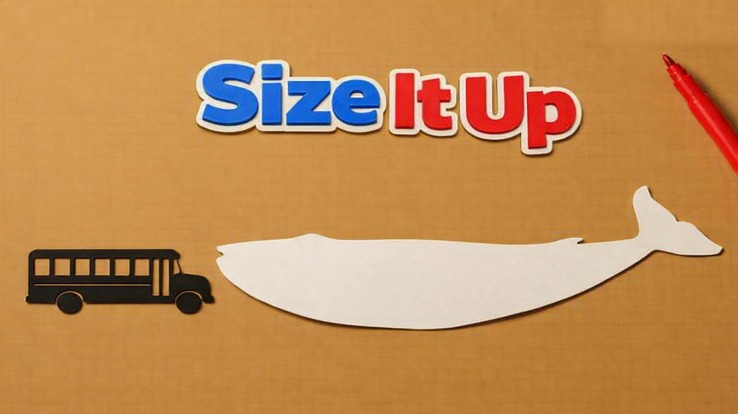
Size It Up asks a question most people never think about: how good is your eye, really? Each round drops a target object next to a known reference, and the job is to resize that target until the proportions finally look right.
Why Size It Up Feels Different
Most browser puzzles reward speed or memory. This one rewards something harder to fake, a genuine feel for scale. Two objects sit side by side on screen. One has a fixed, stated size and acts as the anchor. The other is thrown wildly out of proportion at the start of every round, and only patient adjustment brings it back into line. There is no clock ticking in the corner, so the honest struggle is between what your eyes believe and what the numbers eventually confirm.
How To Play
Getting started takes about ten seconds of trial and error. Look at the reference object first and register its stated size in your head. Then drag or scroll the target object until its proportions feel believable next to that anchor. Resist the urge to lock in too early; small corrections near the end usually matter more than the first big jump. Once satisfied, commit the answer and watch the real size get revealed alongside a score.
The Core Gameplay Loop
Five comparisons make up a single day, and each one repeats the same quiet cycle. Look, adjust, commit, then find out how wrong or right the guess was. A perfect round pays out 100 points, so a flawless day tops out at 500. Because the loop is short, players tend to replay yesterday's mistakes in their head rather than the current puzzle, which is arguably the most addictive part of the format.
What Stands Out
The object pool pulls from ordinary life rather than obscure trivia, think furniture, landmarks, tools, and animals, so the challenge feels grounded instead of academic. Scores are easy to screenshot and share, which explains why comparisons pop up on social feeds the way Wordle grids once did. The scoring curve is also fairly forgiving of a near miss while still punishing a wild guess, so one bad round rarely ruins the whole session.
Tips For A Better Score
Anchor your judgment against something physical near your screen, a hand, a doorway frame, even a phone. For larger objects, break the shape into smaller mental chunks instead of eyeballing the whole thing at once; a building is easier to judge floor by floor than in one glance. Watch the image for perspective tricks before touching the slider, since camera angle distorts apparent size more than people expect. Slow down specifically on the last small adjustment, because most points are lost in that final stretch, not the first rough guess. Finally, keep a mental note of which categories keep fooling you, whether that is vehicles, buildings, or small household items, and study a few real dimensions in that category between sessions.
Final Thoughts
What makes Size It Up worth returning to is how ordinary the underlying skill feels until you are actually tested on it. Most people assume they have a decent sense of scale simply from navigating rooms, streets, and everyday objects, yet the game exposes how much of that confidence relies on context clues rather than real judgment. Strip away the surrounding cues, place two unrelated objects side by side, and the guessing suddenly gets harder than expected.
The format also holds up better than many daily puzzles because the skill it measures actually improves with practice. Unlike trivia, where knowledge either exists or it does not, estimation sharpens the more a player deliberately compares guesses against revealed answers. A newcomer scoring low in the first week can reasonably expect steadier results a month later, provided they pay attention to where the biggest misses happen.
Where the game runs into limits is variety within a single session. Five rounds pass quickly, and players chasing a longer session will need to wait for the next day's set rather than replay endlessly. That constraint is intentional, tied to the same daily rhythm that keeps Wordle and similar puzzles relevant, but it is worth setting expectations accordingly before diving in.
Taken together, the combination of a simple core mechanic, a short but meaningful scoring window, and a skill that visibly improves over time is what separates this from a throwaway browser distraction. Anyone who enjoys quiet mental challenges, and who is willing to be a little humbled by their own assumptions about size, will likely find five minutes a day well spent here.
Discuss Size It Up