








































Wave Race
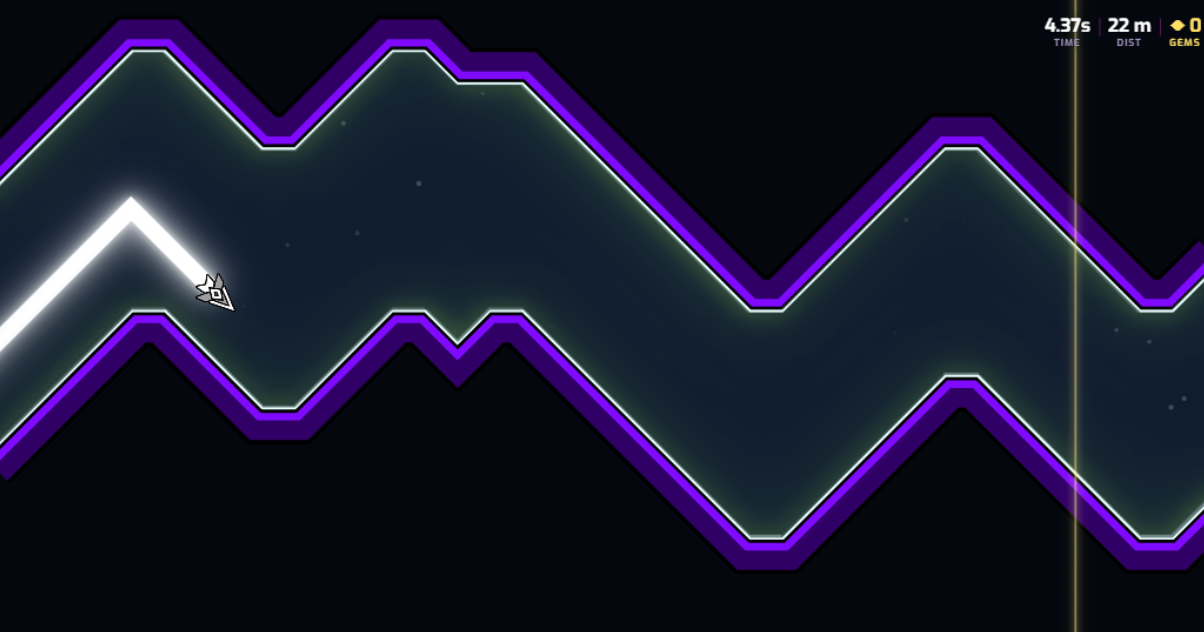
Wave Race Puts Players Through a Breathless Zigzag Test. This browser arcade game features a small arrow that travels through tight corridors filled with spikes and moving hazards, testing timing rather than speed.
Gameplay
One input controls everything. Holding sends the arrow climbing at an angle, letting go brings it back down, and the two actions strung together form the zigzag path that gives the game its rhythm.
- Left mouse button, spacebar, or the W key trigger the climb on desktop
- Touching and holding the screen does the same on mobile
- Letting go at any point starts an immediate descent
- The P key pauses mid run
Nothing in Wave Race sits still. The arrow is always climbing or falling, never hovering, so a player's attention can't really drift even for a second.
Standout Features
A few things stand out after spending time with the courses:
- One control scheme, which keeps the learning curve short even if mastery takes longer
- A mix of spikes, walls, and rotating gears that forces different reactions rather than repeating the same dodge
- Difficulty that climbs steadily, from wide forgiving corridors early on to gaps that leave almost no margin later
- Restarts that happen in a second or two, so a crash costs time but rarely momentum
- Progress tied purely to execution, with nothing to buy, unlock, or grind toward
Comparing Wave Race to Geometry Dash Wave Mode
Geometry Dash has a mode called Wave, where a diamond shaped object rises and falls under the same hold and release logic, locked tightly to the beat of a music track. The overlap with Wave Race is real, but the two diverge once you look past the shared control scheme.
Tips for Playing Wave Race Well
A handful of habits separate players who clear the harder courses from those who stall out early:
- Use short taps rather than long holds once the passage narrows, since a half second of extra holding is often the difference between clearing a gap and clipping it
- Keep your eyes two or three obstacles ahead rather than locked on the arrow, since reacting to what's directly in front is usually too late
- Start adjusting height before a passage shifts direction, not after, because corrections made mid turn tend to overshoot
- Treat a section you keep failing as something to memorize, not something to react to on the fly, since the layout never changes between attempts
- Resist the urge to speed up through dense clusters of obstacles, since most crashes come from rushed inputs rather than the obstacles themselves being unfair
Conclusion
What makes Wave Race worth returning to isn't the premise, which is about as simple as arcade games get, but how much that premise exposes about a player's own habits. A long hold that feels natural in an open stretch becomes a liability the moment the corridor narrows, and most players only notice this after several failed runs teach them where their timing actually breaks down. That's the real loop here: not beating a level once, but rebuilding muscle memory around a specific sequence of turns until the input stops being a conscious decision and becomes closer to reflex.
This also explains why the game holds up despite having no story, no characters, and no progression system beyond the courses themselves. The difficulty curve does the job those systems usually handle in other games, giving players a reason to keep attempting a section instead of walking away. Compared to something like Geometry Dash Wave, where music carries part of the timing for you, Wave Race asks players to build that internal clock on their own, which is a slower process but arguably a more transferable skill once it clicks. For anyone who enjoys games that punish sloppiness without punishing curiosity, that trade off is the whole appeal.
Discuss Wave Race